Thursday, January 25, 2018

BW Relationship with EPM 10.1


For those BW consultants who had experience with executing the UJ's command from the backend and writing script logic, the new EPM 10 interface is a breeze for them to relate the interface with the backend program.


The new interface that is designed to enhance user intuitiveness.

Web based EPM 10.1


Data Manager


Tcode:

UJFS -   Give you information about the files in BPC server, like AL11 for BPC


UJKT -  A test tools which allows you to test the script logic in backend such as perform carry
forward via backend which correlate to perform Carry Forward activity  under EPM 'My Activities'


At EPM 10.1 frontend


At excel based Data Manager package


UJBR - Backup and restore tool for BPC objects


Table:

UJP_PROC_STEP or UJP_PROC_STEP_A - check the User ID in which environment and also the activities performed in BPC. Usually this is used to mark 'X' to 'kill' the user's job when faces error such as Journal posting.


Script Logic:

At UJFS:


At the EPM Administration:


Useful reference:


https://corporateperformanceintelligence.wordpress.com/2013/08/21/some-important-sap-bpc-transaction-codes/

Tuesday, September 26, 2017

SAP HANA Studio for BW Modeling

For BW 7.5 on HANA, we  can use the HANA Studio to model the new BW objects based on Eclipse technology such as Advanced DSO, CompositeProvider, ABAP CDS view, ODP SAP Extractors (leverage HANA runtime) etc.

As this version is a bridge to BW4HANA, some modeling will still be done in the SAP GUI and some on HANA Studio.

To get this started, first we need to download SAP_HANA_STUDIO (it will be something like IMC_STUDIO2_97_3-80000323.SAR) and SAPCAR to extract  .SAR content. To extract SAR files, refer to this link.

After installation , go to Help and Install New Software


You will be prompted for an entry , type in Eclipse Neon repository - http://download.eclipse.org/releases/neon (The sequence of release for HANA studio starts with luna -> mars -> neon as in L,M,N)


Choose for  ABAP Development Tools & BW Modeling tools


After installation, restart the HANA Studio and change the perspective


Choose BW Modelling


Next create a New BW Modeling project


Select the SAP connections to connect to the SAP BW objects you need to work with or enhance


Once connected, you are able to view the SAP BW objects at your right panel


Note: Try to install from the luna version  if the components from luna version cannot be installed from your system and then upgrade the version.

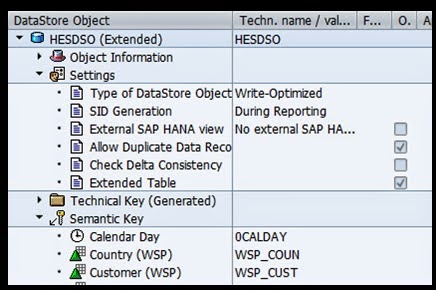
In HANA Studio, the version of DSO can be differentiate from "Classic" and "Advanced"


Monday, January 30, 2017

All about Data

We have heard a lot about data technologies and tools. There is data modelling, data quality, metadata management, data governance, data stewardship, data lineage, data profiling and so on. Let's figure out just HOW does all these concepts fit together. So basically it means this -  We need to understand the data we have , design and arrange it in a logical manner, centralize the pool of data and then map those data to its business definition by enforcing a standardization and governance process. When we have those in place, we can further understand the quality of the data by setting up the business rules to check the data correctness and  subsequently trace it back to the original source. This process is a continuous journey and the further we go, the better our data quality and governance are, and yes corporate jargon call this as Data Strategy.So when we have all these concepts and understanding in place aka the Data Strategy, we can choose the solution from one or a combination of tools from vendors like SAP Power Designer, Information Steward, Informatica, Erwin , ER/Studio, Collibra that meet our budget and IT environment to implement it.


Monday, April 4, 2016

Reality of Business Critical Reports

Recently I had a few sessions conducting asessment across the Support team to understand their concerns and criticality of the support procedures. I threw in questions like what if the BI system were to decommision now, what they forsee that will trigger a huge impact? And to sum up all the conversations that took place, there are many reports supported but the most critical ones being the financial management reports that use the BI platform for business view mapping and data transformation. The usage of these reports had become an integral part of the support mechanism as every month end of financial report submission, there is already a process in place that involve both IT Support and business users in area of data validation and tracing, mapping upload and changes all the way to rectifying posting issues when there is discrepencies reported in BI report total sum value when compared to the operational reports. Hence the criticality and success of BI is actually largely supported by the ongoing process that involve both IT Suport and business that enable the usage of it to be an integral part of bau.

Wednesday, March 23, 2016

Delta Load Implementation

As ETL tool such as Data Services and SSIS evolve, we can see there are request to extract SAP ECC tables directly out from the source (without going through SAP BW). There are a lot of considerations when we land on that approach mainly around the corporate datawarehouse roadmap and data policy, the standard EAI layer and the delta load mechanism.

When this approach is adopted, an organization should evaluate their existing datawarehouse such as SAP BW and the implication of single source of truth when data is extracted out into another system. Is the staging system supposedly to be a global datawarehouse in long run, is it planned to be the regional datawarehouse layer or just to cater for silo project as a 'dump' or staging area to transform some data to meet silo business unit reporting needs?

On the technical side, I always put emphasize on the delta mechanism as there is quite an in depth configuration at the ECC end. The common delta method may be timestamp and there are certain tables that store the timestamp records when transactional records were added. There are also log table to detect changes or deletion in records. And during data load there is additive or overwrite records functions. Another interesting area to take into account is the initial load. Some huge extraction from multiple tables with complex join require setup tables to populate huge historical dataset first before the delta take place. This is a pointer noted for performance consideration. 

I came across design using Data Services to extract data directly from huge ECC tables that prior to loading read from an ABAP program which identify the delta mechanism or logic such as reversal of posting etc. Any approach that the organization takes for data extraction, it is good to cover all the area during IT strategy or solution stage from BI roadmap to the technical and security assessment of the solution.

P/s this is a good read on delta methods

Monday, February 15, 2016

The Foundation Must Be Right

We hear a lot about the power of business intelligence through predictive analysis and data mining, the need of dashboard for overview and decision making and the empowerment of operational users through self service reporting. These are outcome of a successful BI practices supported by mandatory pillars - BI Framework , Data Foundation , Business Driven Values.

Thursday, January 14, 2016

BI Improvement

I was assigned to lead the BI improvement task in my organization and I started off with a very detail study of the existing BW environment from the start of the system to date. To tell a technical story is always based on facts and statistic.To link statistic to improvement is a challenge. There are thousands of BW objects and to start is a challenge itself.

So I started out by accessing the current state from three perspectives -> Common Shared Layer, Data Integrity and Usage. I tracked down the objects in a chronological manner by years and projects. To determine common shared objects and layers, I go into the main multiprovider that zooms down to the datasources. I listed down all the datasources and the direct propagation layers. Next I listed down all the main infoobjects use in the main query and map it to the business context. And I checked on the last access date of the query. 

With this analysis results, I am able to derive the statistic on the number of projects that do not shared the common layers and objects to prove that the projects run in silo, how many master data with the same business context are created to prove that there is no single source of truth for reporting within the same ECC module and the last access of the queries to prove the BI usage. This analysis will act as the current state to measure how much we are able to improve by comparing the same statistics after implementing the improvements plan.

And how does this relate to cost saving over the time? That is my next challenge to come up with facts and findings that can tell this 'story' from financial perspective. 


Monday, January 11, 2016

Data Lineage in SAP Environment

It is great to hear that SAP metadata management has the coverage of end to end SAP environment that leverage on Information Steward features such as Metadata Management and Metapedia. But the tool itself cannot be a standalone feature when it comes to the  purpose of data lineage initiatives that is to ensure the data accuracy and data standardization. We still need to enforce a process to govern the custom master data metadata in BW environment that must be rooted to the source of master data in ECC.

This is a good read on Metadata Management in SAP Landscape.

Tuesday, December 29, 2015

A Look at SAP BI Servers Landscape

In many organizations that is going into the maturity stage of BI, there will be additional service offerings brought into the business and as the technology evolves. Many already embarked on Business Object 4.1 as their BI frontend reporting tool and SAP BW as their datawareouse. When the needs of Data Services and Information Steward arises for the purpose of data profiling and cleansing, the existing landscape has to be scalable to ensure that there is always the first emphasize made on single source of truth for reporting and this is very much refer to data structure and master data. Below is an example of the architecture landscape proposed on the aforementioned.


Please also note that the BO 4.1, DS and IS servers share the same server but with own repository and services. Architecturally, IS and DS are inseparable in that IS relies on DS.  In addition, they have a lot in common as well, they both leverage Information Platform Services (IPS).  Information Steward and Data Services both rely on CMS services for centralized user and group management, security, administrative housekeeping, RFC Server hosting and services for integrating with other SAP BusinessObjects software (i.e. BI Launch Pad).

For more information:
http://scn.sap.com/community/information-steward/blog?start=0


Friday, March 27, 2015

Relating Visual Analytics with daily life

Recently we have implemented Good Service Tax of 6% and this is how we can view it from a Heatmap, a way we can illustrate visual analytic in our daily event.The space indicate the proportion of the GST to monthly salary, the intensity of the color depicts the volume of the figures, the higher or bigger the darker the color.


Wednesday, August 20, 2014

Cloud Computing... I am coming

Lately I'd been bombarded with the 3 famous technical jargon - IaaS, PaaS,SaaS. Depending on the vendors, for SAP they put it as IaaS, DbaaS, PaaS.

As we mature into the cloud technology, it is really the time to think about a plan to adopt this robust framework and more importantly is to plan out a strategic transition phase to move from on premise platform to the cloud. There will also be an intermediate phase in which we need to factor in the extension of existing on-premise solutions to the cloud solutions.

It is exciting to imagine that in the future everything in the future is accessible from the cloud and there is nothing that we need to install or stored locally anywhere in our own devices. We can tap on to any device and start to work! We can use any applications through subscription base and in a way allowing deployment to be more agile and flexible.

Wednesday, May 21, 2014

Governance and Enforcement

Governance as we always hear it is nothing new at all in IT world. We create a set of standards and conventions in order to ensure things can be done more efficiently in long run and minimal risk of downtime incur to BAU. New developments or changes has to go through approval board, some call it CAB. However most approval process are merely a decision based on written regulation in the big governance book and not made to help the business achieve the goal of having governance at the first place - that is to enable things to run more efficiently in long run and ensuring minimal risk of BAU downtime.

This in turn result in the inefficiency of the governance framework in an organization as it is treated as enforcement rather than governance. A lot of governance framework in an organization is not revised over times and this contribute to the inefficiency of governance in an environment that is fluid and change over time. In BW project, a lot of project consultant finds it hard to perform after go live support that require immediate fix as they have to go through rounds of approval for transports and they are not allow to directly create objects in Production environment that support emergency data load such as infopackage. 

At the end, if the rules in the governance book is not bent to suit the business needs and its urgency, this is merely blind enforcement and not a practical way of governing a system. A lot may argue that if we allow it to happen one time, it will happen again. So in short , it is up to the governance board to exercise their power in tackling difficult situation and that is when in depth knowledge, experience and exposures are important criteria for an effective governance authority.


Tuesday, May 6, 2014

R - A Cool Guy with Serious Thoughts on Enterprise Technology

I got to know this cool guy 'R' who is an expert in telling you how disruptive technologies and new business models can impact the enterprise. I guess this is the kind of guy a lot of big organizations need to engage with before embarking on a serious of new technology adoptions. And not directly engage with Products vendors who is more bias in their own offerings.

Hi R,

I stumbled on your very good blog at http://blog.softwareinsider.org and here’s my POV.

Firstly, many organizations are still not mature in terms of BI and how it can really bring in the ROI. They started with BW as the backend and Bex query, Analyzer and WAD as the frontend. Initially dashboard is not that impressive when it was deployed from WAD so BO come into place with Xcelsius. Although Xcelsius can produce some impressive features, it is not really integrated with BW objects as compared to WAD and maintenance is very high. Most time was spent to develop the dashboards rather than looking into the data and business values. Over the next couple of months , we started to hear about Project Zen which eventually become Design Studio that looks something like WAD but with more features such as HTML5 and mobile integration (MOBI). We also have Advanced Analysis and BO Explorer that can directly consume data from HANA model.

As we continue with the technology advancement, we start to hear about Lumira as a Visual Storytelling tool. It is bundled in SAP HANA license so having HANA is mandatory. Lumira can produce very fast and interactive self-service dashboard when it consume directly from HANA model. But wait, remember in Gartner Magic Quadrant we have Tableau that rank the highest in data visualization and BI space. And even SAP has plug-ins ready for HANA to be consumed directly in Tableau. So there goes another debate for some companies, Lumira or Tableau.

Apart from that, not to mention there is also EPM tool for some power users who access the financial consolidation report. Imagine what the user will be getting when he opens his Excel early in the morning – he sees Bex Analyzer for reports which is not migrated yet , Advanced Analysis  for new reports and EPM for Consolidation and Planning reports. They also have the web based reports in BO portal (Webi and Xcelsius), self-service reports in BO Explorer and some old WAD and Bex reports in Enterprise Portal. In real life scenario, when we introduce new technologies, it does not happen in a clean cut manner but  through  gradual adoption and migration. All these incur cost and time. At the end, the management will ask the questions, is there any alternative besides getting in HANA, BO, Lumira etc. As for end users, they will be confused with so many tools they need to adopt.

On the application development site, how HANA become a game changer is through SAP River and Eclipse platform. So imagine data consume directly from HANA straight into web application layer on Eclipse using SAP River, what is the ‘new’ direction for application development now ? Do we shift from SAP platform to Eclipse platform now? Webdynpro ,workflow and ABAP to JAVA & SQL?

When HANA model become the major part of data acquisition for all the tools above, no doubts HANA Studio is going to be the new ‘RSA1’. And guess what, many BW developers out there are struggling to get a project that can give them the opportunity to pick up skills in HANA Studio.

In terms of BI, it is not only about technology advancement but also about the governance of data quality in the organization. So when the technology advances, most companies still struggle with the data quality or sap ECC convergence into global instance. To have a successful BI, these two main factors has to complement each other and be executed at the right track by the right party in the holistic BI roadmap.

Ok, back to real questions – HANA, so what does all these has to do with HANA and the direction? Simple. All of the new technology and tools are geared towards the HANA platform. It does not only change the company BI strategies but the People, Process , Innovation Trends and Jobs . So you can see now how big the impact is to the world out there with the new direction.

There you have it my POV. I am more on an enthusiast on the whole SAP BI innovations and how it evolves over the time, keen to gain and share and learn from feedbacks and POV from expert like you!


Saturday, May 3, 2014

The trends in Analytics - Tableau vs Lumira

We used to hear BI reports requests coming from everywhere, then we start to notice everyone suddenly is talking about Dashboards and now we call it 'Visual Storytelling'.  I am a BI developer all my career. On the presentation layer I'd worked on Crystal Reports all the way to Bex report, WAD,Webi, Xcelsius, Explorer etc. I also had the opportunity to work with non-SAP tool like Actuate and to some extend macro on excel.

In most cases, operational reports can be developed in Abap reports residing in ECC except those with complex mappings. For management reports, we need highly aggregated data and that's where dashboards come into place. It seems over the years, dashboards without the flow of guided data interpretation,self-service capability and mobility are not really effective to provide informed decision making data on the go. Hence you see that Visual Analytics tool such as Tableau, Lumira and Qlikview are fast becoming an interest in big organization.  The functions of a BI developer is more challenging and interesting as we need to use our technical expertise combine with our functional knowledge and interaction with business together with some creativity in visual representation of data to derive business visual story from the dashboard.

Among the tools for Visual Analytic I am working on is Tableau and Lumira. It seems Tableau is more mature in the Visual Analytic space and Lumira is actually SAP BO Visualizer that is wrap under HANA licence and it integrates directly with HANA model. Tableau by far fetch sits at the highest position in Gartner Magic Quadrant.But I always believe the position in Gartner Magic Quadrant does not mean anything concrete for the reason that product is selected as an organization  groupwide  BI tool. We must choose the right technology based on the integration of business processes and technology platforms because at the end ,accuracy and single source of truth speak the loudest in the Analytics space; not the impressive animation on the dashboard.So it is time for us to really test out the pros and cons of each technology. Having to say that, we need to bear in mind that the ultimate winning point should be the ability to tell a good business story accurately and not the name of the product or where it sits at the Magic Quadrant.


Thursday, May 1, 2014

Start looking at HANA as a Platform, not any platform but Innovation Platform!

For any debate or review process from Solution Architects over which  in-memory technology that best fit into an organization given that the fact Microsoft and Oracle database has its own in-memory capability build in, do not just look at HANA as a 'faster horse' but here are a couple of very valid and professional points from Wally Concil ,SAP North America. He iterates that we need to bring HANA in as a platform to enable transformation innovation. And what he meant by that is to put the innovation into business processes.Technology is a disconnected business process for most big organization and HANA platform can be expanded to produce an integrated end to end process for what used to be silo approach sitting on different department. And that can rapidly deliver on the breath of the solution.


Thursday, April 24, 2014

Does SAP HANA Replace BW? (Hint: Still, No.)

This time , I participated in the blog discussion, indeed a topic that can only grow over time.

http://www.saphana.com/community/blogs/blog/2014/04/17/does-sap-hana-replace-bw-hint-still-no#comment-5510

I am particularly interested in the below statement:
  • If you just have ERP as an operational standalone system then put ERP on HANA and use HANA Live
  • If you just need a data-mart alongside ERP then use HANA Enterprise and SLT for real-time replication
  • If you don't have BW and need an EDW then use BW on HANA, preferably with ERP on HANA and HANA Live


Monday, April 14, 2014

A pragmatic BI Vision


BI won’t work without single source of truth, BI governance, evolving innovation, streamlining with backend technology and self-servicing frontend. All these components are inter-related and play a vital role in the BI roadmap .

Monday, April 7, 2014

BW on HANA , how it speeds up things?

The BW OLAP engine has now become the OLAP Compiler for HANA, also known as the Analytic Manager, pushing down further OLAP operations down to HANA provides offering unrivaled query performance. Additional business insights can be achieved by overcoming existing ABAP based limits. A summary of the OLAP features pushed down into the HANA database is summarized below:

OLAP Features pushed down to HANA in BW 7.3x
  • Restricted key figures
  • Exception Aggregation CNT for quantity key figures without unit conversion
  • Exception Aggregation of currency key figures with optional currency conversion

OLAP Features pushed down to HANA in BW 7.4 SP5
  • Avoid intermediate result set materialization (e.g. Exception Aggregation)

OLAP Features pushed down to HANA in BW 7.4 SP6 and beyond
  • Stock coverage Key Figure
  • Hierarchy Handling
  • Formula exception aggregation
  • Processing of further query scenarios in HANA (Joins, Union, etc.)
  • Handling of inventory Key Figures
* Pluck from http://www.agilityworks.co.uk/our-blog/sap-bw-7-4-sp5-on-hana-better-smarter-faster/


Saturday, April 5, 2014

Everything suddenly seems NEW NEW NEW & BIG BIG BIG

I'd been doing some research over the weekend, well what a way to enjoy life but it is interesting yet troubling for me to grasp so many new things happening in SAP technology. And by this I am not just referring to the new kid in town - HANA Studio. 

SAP HANA Cloud Portal

http://www.sweetlets.com/w/2013/06/hana-cloud-portal-from-the-perspective-of-a-test-partner/


Unified development environment for BW via Eclipse

http://www.agilityworks.co.uk/our-blog/sap-bw-7-4-sp5-on-hana-better-smarter-faster/


SAP BW 7.4 Generates HANA Views accessible via SAP Lumira

http://www.youtube.com/watch?feature=player_embedded&v=33PR1w2_pzs


SAP RIVER

I registered for a trial version but the river is always flooded!! But in short , this is the new language to develop web application base on SAP HANA. 


It is mind boggling technology for a lot of  BW/BO Consultants out there. I bet most of them are hoping to play on the ground of  BW 7.4 on HANA now!